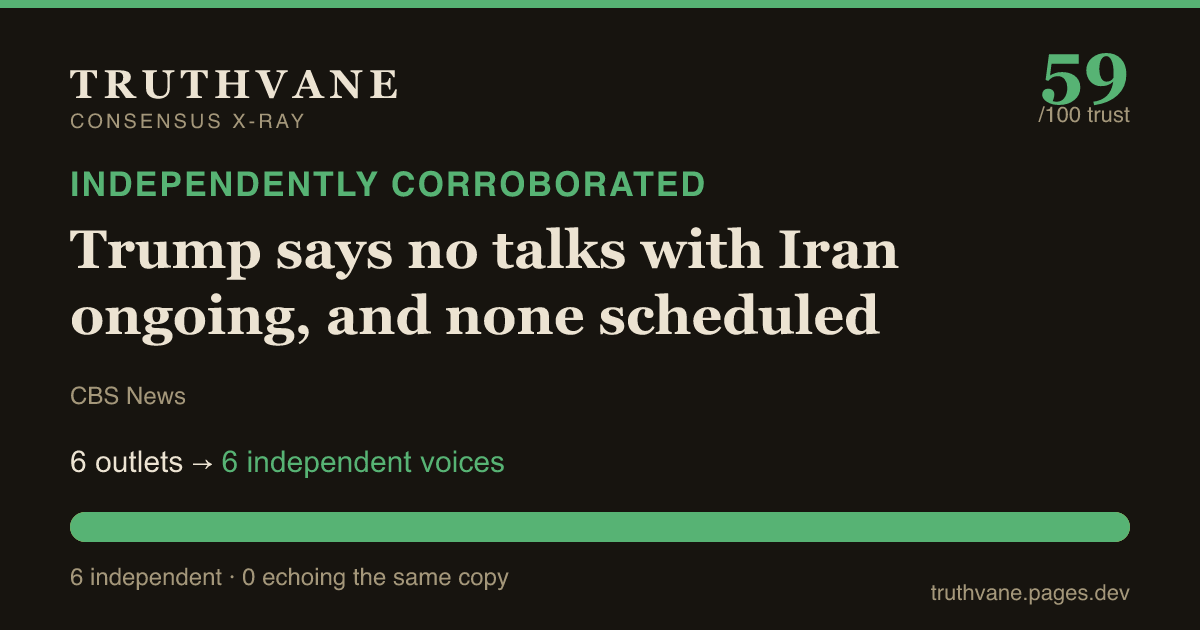
Trump says no talks with Iran ongoing, and none scheduled
CBS News · LC · trust 59/100
Updated on: August 18, 2026 / 12:47 PM EDT / CBS News
United Nations inspectors have found "a few tons" of nuclear material at a previously secret Syrian nuclear site, according to the U.N.'s International Atomic Energy Agency.
IAEA Director General Rafael Grossi said Tuesday that Syria's new government had opened the site in Deir ez-Zor to international inspectors.
"Today is an important day for security and peace and the indispensable efforts in the field of nuclear non-proliferation, where we began cooperation with the new Syrian government, while the previous regime did not cooperate in this field," he said on a visit to Damascus.
Grossi said the IAEA has worked with Syria's new government for 18 months and was granted access to the Deir ez-Zor site, which was operated by the previous regime.
"We found a few tons of nuclear material that could be misused," he said, adding that substantial work was still needed to establish a complete picture of Syria's nuclear-related materials.
"It is important to have full clarity regarding the nuclear materials in order to strengthen international cooperation," he said.
Syrian Foreign Minister Asaad al-Shibani, speaking alongside Grossi, said Syria's "transparency is a voluntary choice."
He said the nuclear material would remain in the country, for "peaceful purposes."
Lebanese President Joseph Aoun will head to Rome this week for talks on the future of the United Nations peacekeeping force in south Lebanon, whose mandate ends this year, a Lebanese official told the AFP news agency.
The visit scheduled for Thursday comes after Italy and France said in June that they wanted to set up a multinational coalition to succeed the U.N. Interim Force in Lebanon, known as UNIFIL.
Both countries provide the U.N. force with large troop contingents.
Aoun is to meet his counterpart Sergio Mattarella and Prime Minister Giorgia Meloni to discuss "the future of the international forces, particularly in light of the French-Italian initiative to set up a force to replace UNIFIL," the official told AFP, speaking on condition of anonymity.
Aoun will also meet Pope Leo XIV at the Vatican and brief him on "the contacts Lebanon has been making since negotiations began" with Israel, the official added.
Aoun has said Lebanon's preferred choice is an extension of UNIFIL's mandate, a move opposed by Israel.
On Monday, he said "the second choice is adopting a formula that ensures the continued presence of international forces in the south," alongside Lebanon's army.
A framework agreement reached in June between Israel and Lebanon calls for the disarmament of Iran-backed Hezbollah, a gradual withdrawal of Israeli forces from south Lebanon and the deployment of the Lebanese army to the region.
Despite a weeks-long lull in fighting, Israel has kept up intermittent strikes and heavy demolition operations in south Lebanon, where its forces have occupied a strip of land stretching around six miles into Lebanese territory.
The United Arab Emirates military said Tuesday that an incoming missile threat was detected, warning residents of possible interceptions for the first time in weeks.
"UAE Air Defence Systems have detected a missile threat directed towards the country," the country's ministry of defense said in a post on X . "If any sounds are heard, they are the result of air defence interceptions."
The UAE, a close U.S. ally, was targeted daily, along with other Persian Gulf states allied with the U.S., by Iran during open hostilities from the onset of the war on Feb. 28. Iran's drone and missile attacks on its neighbors have largely halted since the Islamic Republic signed a memorandum of understanding with the U.S. in mid-June, implementing a very shaky ceasefire.
The UAE last reported incoming Iranian weapons in May.
The government of Qatar, which has been a key mediator in the stalled U.S.-Iran talks, said Tuesday that an agreement between Iran and Oman over future control of the Strait of Hormuz would make it easier to resume negotiations to end the war in the region.
Iran and Oman, both coastal states bordering the strategic waterway, have been discussing the future of navigation through the strait for weeks. Tehran said Monday that the geographical coordinates of new shipping routes through the waterway envisaged by both countries had "been agreed upon."
Oman has not confirmed any looming announcements or agreements with Iran.
President Trump, who has repeatedly said the U.S. should seize and keep control of the strait, warned Monday that if Oman stood in the way of ending the war, the U.S. would "bomb the s**t" out of the country, which has long been a U.S. ally.
Qatari foreign ministry spokesman Majed Al Ansari told reporters Tuesday that a final agreement between Iran and Oman "would make it much easier for us to resume the talks between the United States and Iran."
Earlier on Tuesday, Iran's top negotiator Mohammad Bagher Ghalibaf said the strait would not be reopened unless and until the U.S. meets Tehran's demands, including lifting a naval blockade of Iran's ports.
On Monday, Iran said talks were "continuing in a serious manner" and views were being exchanged on the text of a "joint statement" with Oman.
President Trump said Tuesday that there are no ongoing talks with Iran and no new discussions have been planned, almost six months into the war launched jointly by the U.S. and Israel, which Mr. Trump had said he expected to take no more than six weeks .
"There are no talks or conversations going on, or scheduled, with the Islamic Republic of Iran," he wrote in a post on his Truth Social platform.
"The Naval Blockade remains in full force and effect," he continued. "The Hormuz Strait is open and operating."
"All water mines have been removed or detonated," Mr. Trump added, repeating a claim he made last week.
While some tankers are believed to be getting through the strait with their transponders switched off to effectively hide…
Read the original at CBS News →
Open in TruthVane →